Import supplier products. Keep prices and stock updated.
PIMPORT imports supplier products from XML, YML, CSV and Excel feeds, applies your markup rules, and updates prices and availability on a schedule.
- Free preview of 20 products
- Answer in 1 business day
- Pay after you see it
- Since 2014
- first version released
- 1 business day
- to answer your request
- 20 products
- free preview from your feed
- $100 once
- no subscription
Your products first. Pay after.
Reviewing your feed is free. You pay for installation after the connection is installed and checked.
-
Send your feed
Your store URL, the platform, and a link to the feed or the supplier's website.
-
See 20 of your products
From your own feed, with a quote for the connection.
-
Installation and verification
We install PIMPORT, connect the supplier and set up the schedule. After verifying the agreed result, we issue the invoice.
-
It runs itself
Products, prices and stock update on schedule — with your rules.
Watch a feed become a catalogue.
All program screens →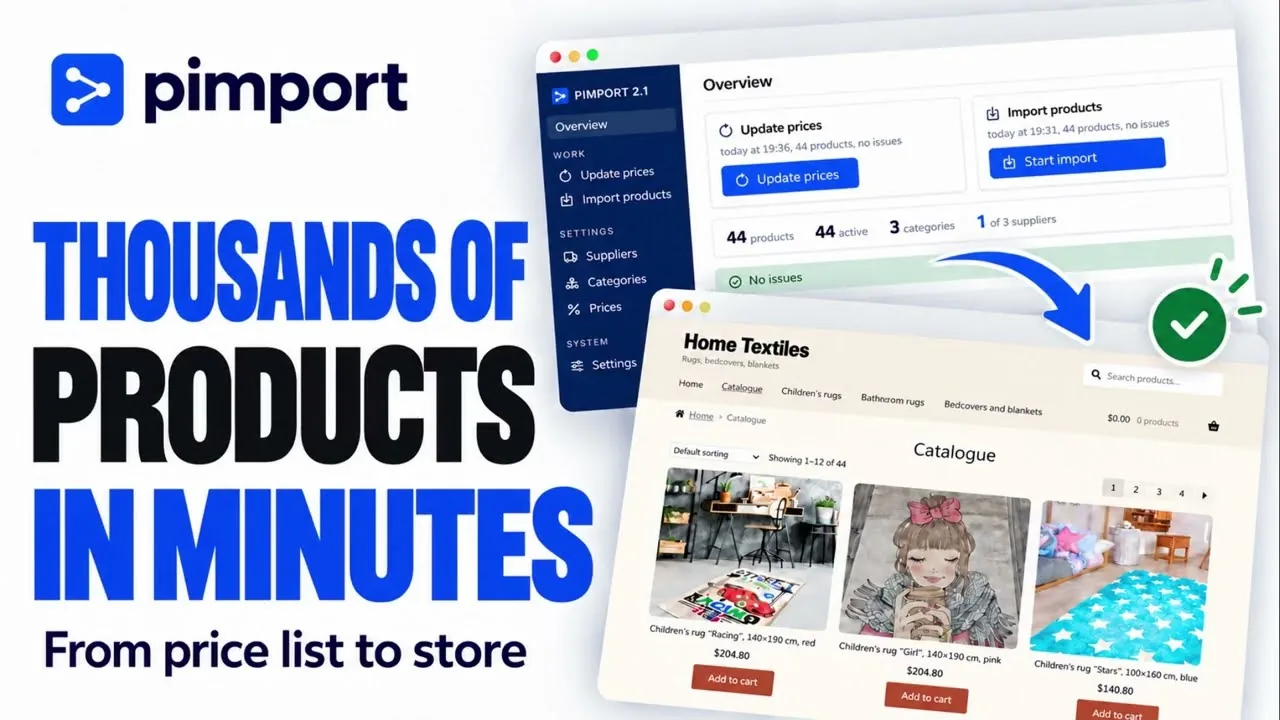
Supplier feeds. A catalogue that stays current.
Prices & stock, on schedule
PIMPORT checks the feed when you say and updates every product — markup included.
Product import
Titles, descriptions, specifications, photos and SKUs from XML, YML, CSV and Excel feeds.
Your markup
By category, brand or price range.
Out of stock
Hiding and returning products — by the update rules you choose.
Your categories, not theirs
Map supplier categories onto your catalogue and choose what to import.
Plugins, paid once
All plugins →Different price ranges. Different markups.
Apply a higher markup to lower-priced products and a lower markup to more expensive ones. Prices are recalculated on each update.
-
Cable +50%300
-
Mug +50%600
-
Rug +30%1,300
-
Headphones +15%4,600
Pay once. Not every month.
The program
One-time payment- Installation on your hosting
- Update schedule set up
- One supplier (XML, YML or CSV)
- Free plugins + a month of support
Monitoring
OptionalWe watch your sources for changes. A store with all its suppliers — $15 a month.
Monitoring terms →Need something custom?
An unusual source, your own pricing rules, an export — we quote before any work starts.
Describe your task →Questions
OpenCart, WooCommerce, Shop-Script and JoomShopping have ready-made integrations. For other platforms and custom-built stores we can develop a separate integration. Send your store URL — we will assess the way to integrate it, the cost and the timeline.
We work with XML, YML, CSV and Excel. Before connecting, we review the structure of your feed and quote the cost.
Send a link to the supplier website. We will check whether the data can be collected from its catalogue and quote the connection.
Updates run on the schedule you set. The achievable frequency depends on the size of the feed and what your hosting allows; we confirm it when connecting.
The program is a one-time payment. Monitoring is billed monthly and is optional. The exact terms are on the Pricing page.
First we show a sample of your products and agree the cost. The terms for paying for the installation and extra services are on the Pricing page.
The program keeps working. Further work and ongoing support are discussed separately; the terms are on the Pricing page.
Yes. Each source gets its own connection and processing rules. Send the feed links and we will assess your task.
Telegram · mail@pimport.net · Write any time · calls 9:00–19:00 Kyiv time
Guides to importing
All articles →- How to import supplier products into your online store How to load products from a supplier feed, choose an import method and avoid duplicates on the next update. A worked example,…
- Repeat imports: avoiding duplicates and keeping your edits Where duplicates come from when a feed is loaded again, which fields to update and which to protect, and how to check…
- Several suppliers in one store: SKUs, prices and availability Separate product pages or one shared page, how to match products across suppliers, whose price to show and what to do with…
Stop doing it by hand.
Send a link to your feed. We'll show 20 of your products and quote the connection cost within one business day.
Show my products